Tag: sourdough

  • Sourdough starter care, week by week

    Everyone who takes our Saturday class goes home with a jar of our starter. About half of them email us within a month to ask whether it has died. It almost never has. Here is what to expect in the first weeks, and what to do about it.
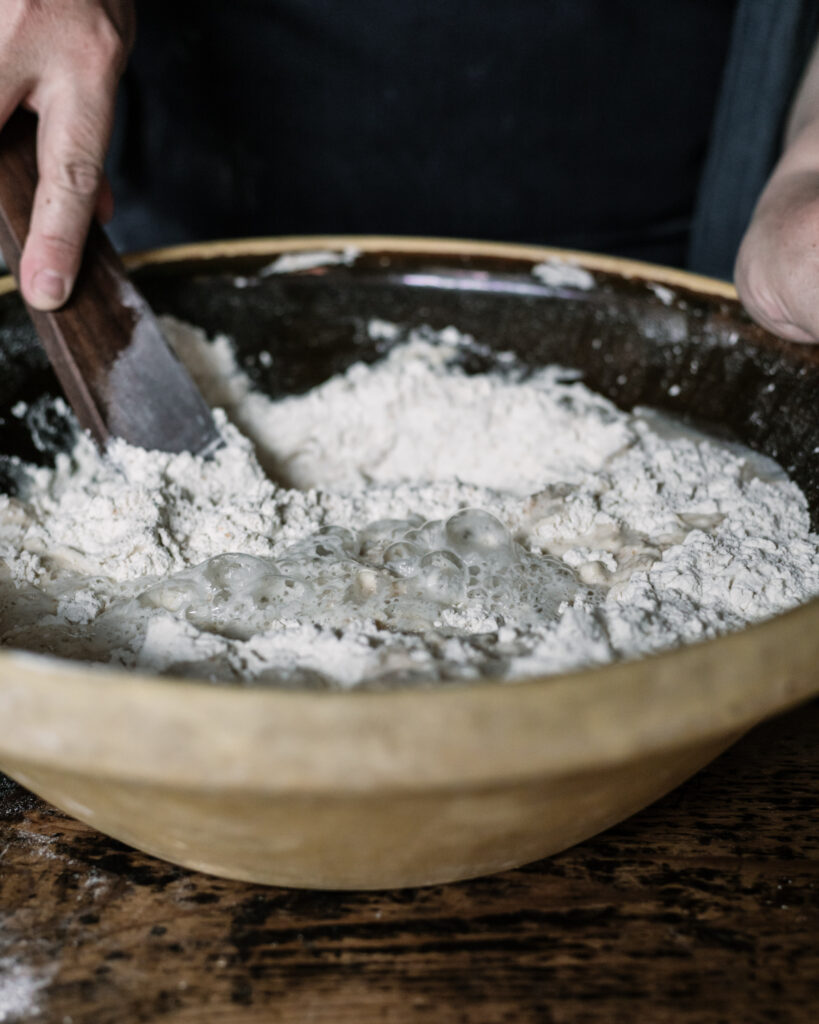
    Sourdough starter being mixed into flour in a bowl
    Photo: William George James, CC BY-SA 4.0, via Wikimedia Commons

    Week one: settle it in

    Your starter has moved from a warm bakery to your kitchen and it will sulk. Feed it once a day with equal weights of flour and water, discarding all but a spoonful first. Keep it somewhere steady, away from the window. Do not bake with it yet.

    Week two: find its rhythm

    By now it should rise and fall on a predictable schedule, usually doubling four to eight hours after a feed. Note the time it peaks. That peak is when it is strongest, and it is when you want to mix your dough.

    Week three onwards: the fridge

    If you bake once a week, keep the starter in the fridge and feed it once a week. Take it out the day before you bake, give it two feeds at room temperature, and it will be ready.

    Signs it is fine, even when it looks alarming

    • A grey liquid on top. That is alcohol from a hungry starter. Pour it off and feed.
    • A sharp, vinegary smell. Same cause, same cure.
    • No rise after one feed. Give it three before worrying.

    The one sign it really is finished: pink or orange streaks, or fuzzy mould. Throw it away and ask us for another jar. We have plenty.

  • Why the lights are on at 4 a.m.

    People ask us two questions more than any other. The first is whether the country loaf is sourdough (it is). The second is why the lights in the back are on at four in the morning. The honest answer is that bread keeps its own hours, and ours are the ones it keeps.

    Golden croissants piled on a tray
    Photo: ViajeroExtraviado, CC0, via Wikimedia Commons

    A sourdough loaf that comes out of the oven at seven was started almost two days earlier. The starter is fed on the first afternoon, the dough is mixed the next morning, it rises slowly through the day and then spends the night in the cold room. By four the next morning it is ready, and it will not wait politely until a more civilised hour.

    Pastry is similar. Croissant dough is laminated the afternoon before and shaped at the end of the day, so that it proves overnight. At four, the first job is turning on the oven, which takes almost an hour to come up to temperature. The second job is coffee.

    A typical morning

    1. 4:00: oven on, dough out of the cold room.
    2. 4:45: first loaves scored and loaded.
    3. 5:30: pastry goes in as the bread comes out.
    4. 6:15: wholesale orders packed for the bicycle.
    5. 7:00: doors open, and the queue is already there.

    We have tried starting later. The bread was fine; the queue was not. So four o’clock it is.